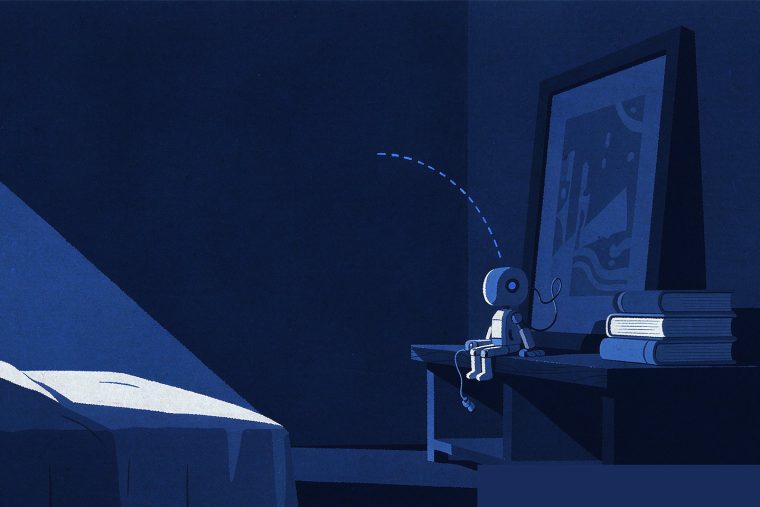
Moxie Robot Is Gone: What Happened in 2026
Embodied shut Moxie down in 2024. A new owner revived it in 2025 and closed in June 2026. What the two shutdowns…
Section
The word “AI” on a toy box currently means at least three different things, and the difference between them is the difference between a product that will last five years and one that will stop working when a company runs out of money.
At the bottom: a fixed set of recorded responses triggered by keywords. This is not new and it is not AI, but it is what most toys under $50 are actually doing. In the middle: a microphone that streams audio to a server, where a large language model generates a reply. That is genuinely a language model, and the toy is a terminal for it. At the top, and still rare: a model small enough to run on the device itself, which keeps working when the network does not.
Almost every buying decision in this category comes down to which of the three you are holding, and almost no product page will tell you. This section starts with the Moxie shutdown, because it is the case study that makes the distinction concrete — a genuinely sophisticated robot that became inert when its maker closed, not because anything broke but because there was nothing left to connect to.
We have not run these toys with a child. What follows comes from published specifications, teardown reporting where it exists, privacy policies, and the documented behaviour of the models involved. Where we are inferring, we say so.
Embodied shut Moxie down in 2024. A new owner revived it in 2025 and closed in June 2026. What the two shutdowns…
There are four questions that separate a real language model from a recorded voice, and you can answer all of them before you buy.
This is the cleanest test and it needs no technical knowledge. Say a sentence that no toy designer would have anticipated — something absurd, or a question about your own kitchen. A scripted toy will either ignore it, deflect with a canned line, or pivot back to its script. A language model will attempt an answer, and the attempt will be visibly improvised.
Both behaviours are worth seeing. The scripted toy is predictable and cannot say anything strange; the model will occasionally say something strange. Which of those you prefer is a values question, not a technical one, and it should be an explicit choice rather than something discovered on Christmas morning.
Switch off the WiFi and repeat the test. A device that keeps holding a conversation is running a model locally. A device that goes silent is a microphone with a speaker attached, and the intelligence lives in a data centre that has an operating cost.
That cost is the whole story. A cloud-dependent toy has a permanent per-user expense that the manufacturer has to fund forever. A $300 robot that costs a few dollars a month to operate is a business that works only at scale, and it works only while the company is growing. This is not a hypothetical risk — it is precisely what ended Moxie.
Any toy that generates language needs a filter between the model and the child, and filters are of wildly different quality. The useful questions are: what categories are blocked, is there human review of flagged conversations, and can a parent see the transcript.
The last one matters most and is often the one that is missing. If you cannot read what the toy said to your child, you have no way to know whether the filter is working — you are trusting a claim you cannot check. A toy with a transcript you can review is worth more than a toy with a better filter you cannot see.
A voice assistant in a bedroom produces a continuous record of a child's speech, and the value of that record is not obvious until you consider that it contains names, school details, family arguments, and the shape of a household. The relevant facts to look for are retention period, whether audio is stored or only transcribed, whether a human ever listens, and whether the data trains anything.
"We may share data with trusted partners" is the sentence to be suspicious of. It is not illegal, it is not unusual, and it means the data leaves the company you chose to trust.
An ordinary toy has one failure mode: it breaks. A connected AI toy has two. It can break, and it can be abandoned.
Abandonment is the harder one because it happens without any warning sign on the hardware. Moxie's robots were undamaged when the service ended; the devices simply had nobody to talk to. The same pattern applies to every cloud-dependent toy, and the risk grows with how sophisticated the toy is — a simple scripted toy degrades to a worse toy, while a conversational one degrades to nothing.
The practical version of this is a budgeting rule: judge the price against the expected number of years of service, not against the hardware. A $150 toy that works for four years costs less per year than a $60 toy that works for one. Since almost no manufacturer will commit to a support window in writing, the prudent assumption is shorter than you would like.
Two things, and neither is teaching.
The first is patience. A model will answer the same question forty times without irritation, which is exactly the behaviour a five-year-old requires and exactly the behaviour no adult can sustain. For a child in the why-why-why stage, this is a real function rather than a novelty.
The second is improvisation. A scripted toy has a fixed script, so a child exhausts it. A model can continue a story in a direction the child chose, which sustains pretend play longer than a fixed narrative does.
What it is not good at is being right. Language models produce confident errors, and a child has no basis for distinguishing a correct explanation from a plausible one. Treat any factual claim from a toy as entertainment, and keep the explanations that matter — the ones about bodies, safety, and other people — with a human who can be corrected.
Under six, a conversational toy provides company and answers, and the child cannot form any model of what the device is doing with their voice. That is the age band where the transcript question matters most. Between six and nine, children start asking where the answers come from, which is the right moment to explain that the toy is talking to a computer somewhere else — an explanation they can usually handle. From ten up, the interesting question stops being whether the toy is safe and becomes whether it is useful, and a child that age will generally reach their own conclusion within a week.
If you are weighing this against the rest of a child's device time, the tablet piece covers the same trade-off for the device most families actually buy, and what the safety labels cover handles the microphone and account questions in more detail.
Usually one of three things, and the boxes do not distinguish them. Cheapest is a fixed set of recorded responses triggered by keywords, which is not AI at all. Next is a microphone streaming audio to a server where a language model writes the reply. Rarest is a model small enough to run on the device. The difference decides whether the toy keeps working when the network or the company does not.
If it depends on a cloud service, usually not. Moxie is the clearest case: the robots were undamaged when the company closed, but with the servers off there was nothing for them to talk to. The test takes thirty seconds — switch off the WiFi and see whether the toy still responds. Whatever still works is what you actually own.
The physical device is as safe as any toy with the same marks. The question is what the conversation produces. A voice assistant in a bedroom generates a continuous record containing names, school details and household routine, so the facts that matter are retention period, whether audio is stored or only transcribed, whether a human ever listens, and whether you can read the transcript. A toy with a transcript you can review is worth more than one with a better filter you cannot see.
Yes, which is why every serious product puts a filter between the model and the child. Filters vary widely and none is perfect. The practical check is whether flagged conversations get human review and whether a parent can see what was said. If you cannot inspect the conversation, you are trusting a claim you cannot verify.
Judge the price against expected years of service rather than against the hardware, because a connected toy can be abandoned as well as broken. A $150 toy that lasts four years costs less per year than a $60 toy that lasts one. What AI genuinely adds is patience — it will answer the same question forty times — and improvisation in pretend play. What it does not add is accuracy, so keep factual explanations with a human.