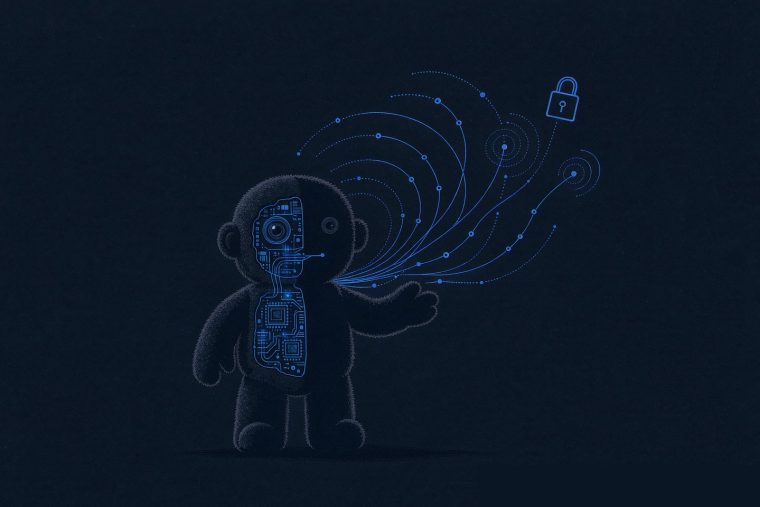
Are Smart Toys Safe? What the Labels Don’t Tell You
The safety marks on a toy box cover choking hazards and battery fires. They say nothing about the microphone, the app, or…
Section
A smart toy passes the same physical safety tests as any other toy. That part is working. What no label covers is the part that makes it smart: a microphone that stays on, a camera that uploads to an account, an app that asks a five-year-old for a birthday, and a server in a country you will never visit.
The question parents actually ask — is this safe for my kid — is three questions stacked on top of each other. Will it choke, burn or cut? Does it listen, record or transmit? And what happens to all of that when the company that built it stops existing? Each one has a different regulator, a different label, and a different way of failing.
This section starts with what the safety marks actually certify and stops exactly where the marks stop. The Moxie shutdown — a working robot turned into a brick overnight — is covered in its own piece, because it is the clearest example of the risk nobody insures against: the toy is fine, the company is gone.
We do not run a physical testing lab and we do not pretend to. What we do is read the standards, read the regulatory filings, and read the reports from people who own the thing. Where a claim cannot be checked, we say that instead of repeating the manufacturer’s wording.
The safety marks on a toy box cover choking hazards and battery fires. They say nothing about the microphone, the app, or…
None of these are on the box, and all five take less than ten minutes together. They are ordered by how often they catch something.
A toy sold in the United States carries ASTM F963 and CPSIA compliance, and if it has small parts it also has to satisfy 16 CFR 1501. Those marks are real, and they are also narrow: they cover choking, sharp edges, flammability, and heavy metals in the paint. They say nothing whatsoever about a microphone.
This is the single most common misunderstanding we see. A parent reads "meets ASTM F963" and concludes the toy is safe. It means the toy is safe to put in a mouth. It says nothing about what the toy does after it connects to your WiFi, because the standard was written for objects and this is now a service.
So treat the two as separate purchases. The physical safety of a $40 robot and a $400 robot is very similar — both had to pass the same choke-hazard rules. Their data behaviour is not similar at all, and cheaper products routinely have worse account handling because there is no legal team reviewing it.
Coin and button cells are the one part of this category that kills children outright, and it happens faster than most parents believe — a lodged cell produces a chemical burn in the oesophagus within about two hours. In the US, Reese's Law now requires child-resistant closures on battery compartments for toys containing button or coin cells, and it has been in force since 2024.
The practical version: turn the toy over, find the compartment, and check that it needs a screwdriver or a deliberate two-step action. If a thumb can slide it open, that toy is a hazard in a house with a child under four, regardless of what the packaging says. This applies to the parent's own devices too — a kitchen scale or a remote left on a table is the same risk.
This is the check almost nobody runs, and it is the one that has already burned thousands of families. Moxie's maker shut down at the end of 2024; the robots had no server to talk to and stopped working. The hardware was undamaged. There was simply nothing on the other end.
The question to ask before purchase is blunt: does this toy do anything with the WiFi switched off? If the answer is no, then what you are buying is a subscription with a plastic body, and its useful life is the company's runway rather than the battery's. That is not automatically a reason to refuse — but it should change what you are willing to pay. A toy that dies with its maker is worth a fraction of one that degrades gracefully.
Under COPPA, a service directed at children under 13 needs verifiable parental consent before collecting personal information, and the FTC has enforced this against toy makers specifically — VTech paid $650,000 in 2018 after a breach exposed the names, birthdates, photos and chat logs of millions of children.
Compliance, though, is a floor rather than a guarantee. The app will often request more than the toy needs: contacts, precise location, photo library, notification permission. Almost none of that is required for the toy to function. Grant the minimum, then check back in a month — permission creep through app updates is normal and quiet.
One habit worth building: create the child's account with a parent's email address, not the child's, and use a display name that is not the child's real name. That single step removes the most common source of accidental disclosure, because the name attached to the account is what ends up in a breach.
Under COPPA and under GDPR Article 17, you can ask for a child's data to be deleted, and the company has to respond. In practice, the request is much easier to make while the account is still active than after the company has announced a shutdown — which is precisely when nobody is answering support email.
Before you set the toy up, find the privacy contact in the app or on the site and note it down. If there is no privacy contact listed anywhere, treat that as a data point about how the company will behave when something goes wrong.
If you only do one thing, do this: switch off the WiFi and hand the toy to the child.
Whatever still works is the toy. Whatever stops is the service. That distinction tells you what you actually own, how long it will last, and how much of your child's behaviour is being sent somewhere else. It takes thirty seconds, it requires no technical knowledge, and it is more informative than every marketing claim on the box combined.
COPPA is a privacy law, not a product standard. It governs how a company collects and handles data from children under 13. It does not certify that the toy is well built, that the AI says sensible things, that the account system is secure, or that the company will exist next year.
A toy can be fully COPPA compliant and still ship with a microphone that records continuously, and it can be non-compliant in ways no parent would ever detect. The label tells you a policy exists. It does not tell you the policy is good.
What actually predicts trouble is smaller and duller: whether the company publishes a security contact, whether the app asks for permissions it does not need, and whether the product page answers the question "what happens to my data if you shut down" without a paragraph of hedging. Companies that have thought about that question tend to have thought about the rest.
Under four, the physical risks dominate and connected features add nothing a child that age can use — buy the plain version. Between four and seven, a child can talk to a device but cannot understand that it is sending that conversation somewhere, which is the age band where supervision matters most and where an always-on microphone in a bedroom is hardest to justify. From eight up, children can understand the trade-off if you explain it, and the more useful move is to make the rules explicit rather than to remove the device.
If you are choosing between specific products rather than between categories, the tablet and headphone pieces apply the same tests to the two devices most likely to be in a child's room, and how we evaluate explains the limits of what we can check from outside.
It means the toy passed the physical safety tests — choking hazards, sharp edges, flammability, and heavy metals in the coating. It says nothing about the microphone, the camera, the account, or the server. A toy can carry the full set of physical marks and still be a connected device with poor account security, because the standard was written for objects rather than for services.
The honest answer is that the box rarely tells you, so test it instead. Switch off the WiFi and see whether the toy still responds. If it does, the voice processing is happening on the device. If it stops, the audio is being sent out to be processed, which means the recording exists somewhere other than the toy. Then read the privacy policy for how long those recordings are retained and whether a human reviews them.
If the toy depends on a cloud service, it usually stops working. This is what happened to Moxie: the hardware was undamaged, but with the servers switched off there was nothing for the robot to talk to. Toys that do their processing on the device degrade far more gracefully — they lose features but keep functioning. Before buying, ask whether the toy does anything at all with the WiFi off.
Yes, but only with verifiable parental consent under COPPA. In practice this means the company must make a reasonable effort to confirm an adult is creating the account. It does not mean the account is safe by default. A useful habit is to register with a parent's email address and a display name that is not the child's real name, so that the identity attached to the account is not the child's identity.
Yes, and the mechanism is different from choking. A coin cell lodged in the oesophagus completes a circuit against the surrounding tissue and produces a chemical burn, which can cause serious injury within roughly two hours. That is why Reese's Law now requires child-resistant battery compartments in the US. The practical test is simple: if the compartment opens without a screwdriver or a deliberate two-step action, it is a hazard in a house with a child under four.