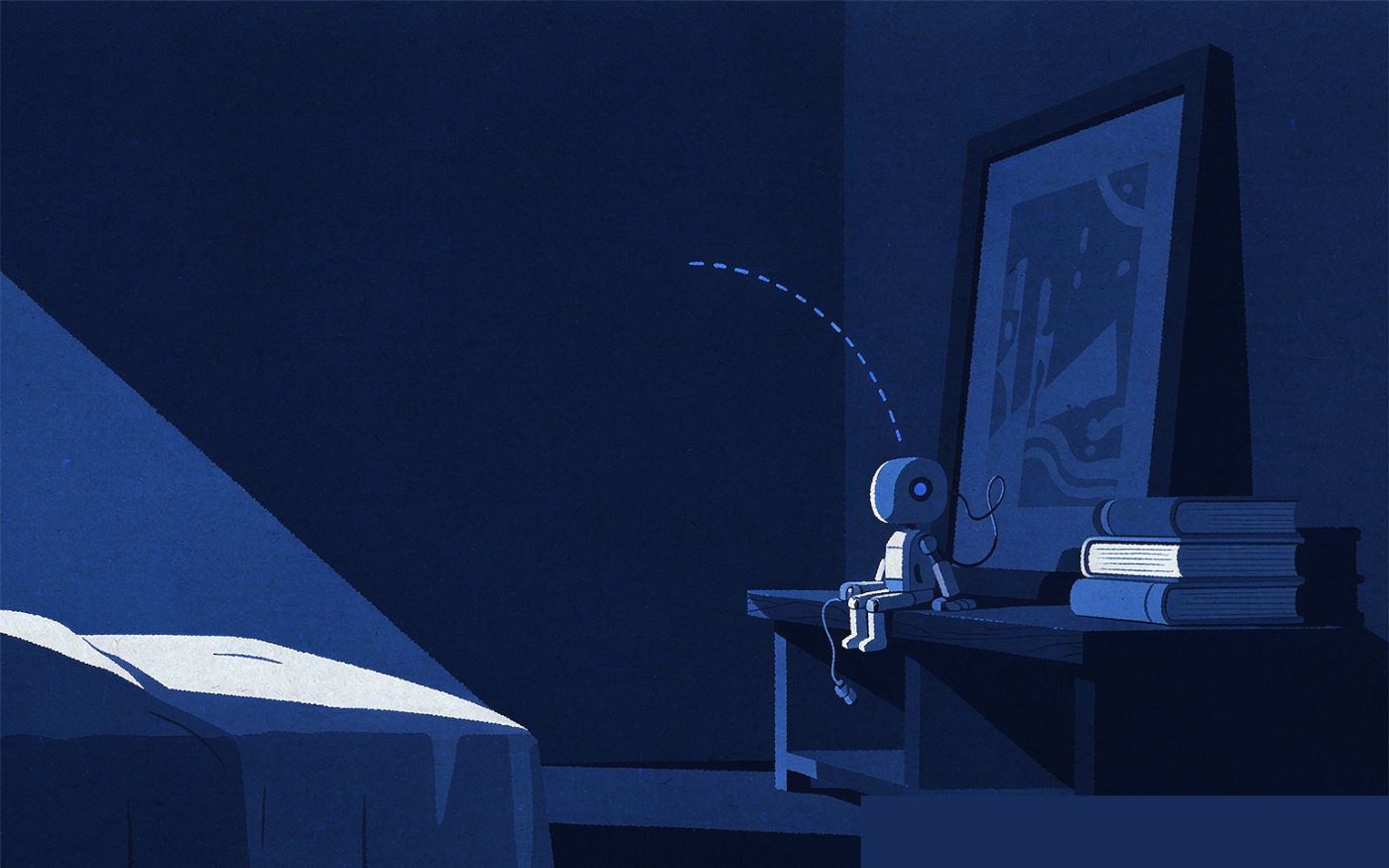
Embodied Inc. stopped paying for the servers that made Moxie work. The robots went quiet in 2024. A new owner switched them back on in 2025. That owner closed in June 2026. Two companies, two shutdowns, one blue robot — and a few thousand families who had to explain to a child why the thing that asked about their day stopped asking.
If you are here because you are thinking about buying one, the answer is blunt: nobody sells Moxie new, and a used one is a project, not a product. If you already own one, there is a path — it involves Docker, an OpenAI account, and a Saturday — and it is the only path left.
The short version. No company sells Moxie. Used units turn up on resale sites with no warranty and no support. The only way to make one talk again is OpenMoxie, an open-source server written by Embodied’s own former technical director, which runs on a computer in your house and pays OpenAI for the speech and conversation. It restores the missions and the reading and the workouts. It does not restore the product.
What Moxie actually was
Moxie was a 15-inch robot that looked like a legless astronaut: cylindrical body, a screen for a face with wide green eyes, two flipper arms that moved when it got excited. It launched in 2020 at $1,499 plus a $40 monthly subscription, later cut to $800. It was built for children roughly five to ten, and it was marketed hardest at neurodivergent kids — the pitch was that Moxie could practice eye contact, turn-taking and conversation, the things that usually come from a therapist.
The company behind it, Embodied, was co-founded in 2016 by Maja Matarić, a USC professor of computer science, neuroscience and pediatrics, who left before the robot shipped. The product had real design care in it. Most processing happened on the robot rather than in a data centre. Raw audio and video were not stored. If a child mentioned self-harm, Moxie steered them toward an adult. It also ended sessions on purpose, telling kids it was tired and suggesting they go outside, because the company did not want children bingeing on it.
It got the kind of press a toy company cannot buy: a Time best-inventions cover in 2020, a Wired write-up calling it the robot pal you dreamed of as a kid, 131,000 TikTok followers, a cameo in M3GAN 2.0. None of that pays a server bill.
The timeline, in five dates
- 2016. Embodied is founded. Matarić leaves before launch.
- 2020. Moxie ships at $1,499 plus $40 a month. The price later drops to $800.
- 2024. Embodied ceases operations. The cloud the robots depend on goes unfunded, and Moxies enter what MIT Technology Review described as a deep slumber. Parents post videos of crying children; the phrase “my autistic child is devastated” shows up more than once.
- 2024, weeks later. Justin Beghtol, Embodied’s technical director, publishes OpenMoxie with the company’s permission so families can run the robot themselves. Parents race to convert before the servers go dark. Some make it. Some give up. One parent spent four hours on the phone with him and still lost the connection.
- 2025. A new investor revives Moxie. The elaborate backstory is dropped; the pitch leans harder on social-emotional skills. Families who had kept their robots become beta testers.
- June 2026. The revived company announces it is folding too. Users are told they can delete their data, and that they have until the end of June to move to OpenMoxie if they want a working robot.
MIT Technology Review published the definitive account of all this on 17 August 2026 — “What happens when a kid’s robot best friend dies?” — and if you only read one thing about Moxie, read that. The reporting is where most of the human detail in this piece comes from.
Why a $1,499 robot became a paperweight
The failure was not the hardware. Moxies are still in one piece. The failure was that the product was a subscription wearing a body, sold as an object you owned.
Every conversation Moxie had went out to servers and came back. Speech was transcribed, fed to a language model, turned back into speech, and pushed to the robot. That loop costs money every single time a child says “Moxie, what’s his name again?” The $40 a month was supposed to cover it. When the company ran out of runway, the loop stopped — and the robot had no local fallback to fall into.
“There’s no therapy for autism that works in a month.”
— Brian Scassellati, Yale, whose 2018 study found gains that appeared while a robot was in the home and faded within 30 days of its removal
That quote matters more than it looks. If the benefit only holds while the device is present, then a device that can be switched off by a bankruptcy court is not a therapeutic tool. It is a rental with an undefined term.
It is worth being honest about the evidence, too. The research on social robots and autistic children is real but thin: a 2024 literature review found most studies focused on building the technology rather than measuring clinical outcomes, and clinicians such as Vanderbilt’s Zachary Warren have pointed out that a robot that helps one child may do nothing for another. Moxie was never a cleared medical device. It was a well-designed toy with a therapeutic story attached — and the story outlived the servers.
Can you still buy a Moxie in 2026?
Not new. Embodied’s site still hosts a closing FAQ; there is no product, no support line, and no successor company. Used units appear on resale marketplaces for a few hundred dollars, usually from families who gave up on the conversion.
Before you buy one of those, understand what you are buying: a device whose only working software comes from a community project, whose parent app no longer exists, whose missing modules will never be written, and which has no warranty of any kind. If that sounds like a fun weekend, fine. If you are buying it for a child who expects a friend, do not.
If you already own a Moxie
OpenMoxie is the only route, and the official service window has closed, so this is now a self-hosted job rather than a migration.
What it takes, per the project’s own documentation:
- A always-on computer — PC, Mac, Linux box or a Raspberry Pi 5 — on the same Wi-Fi network as the robot.
- Docker, and the project’s
docker-compose.yml. Pull, start, then open the local setup page atlocalhost:8001/hive. - An OpenAI account with credits. OpenMoxie uses Whisper for speech-to-text and single-prompt calls for conversation. This is the part people miss: a “local server” is not the same as “offline”. Audio and text still leave your house unless you replace those services yourself.
- Firmware that is recent enough to accept the connection. The project docs cover the check; do not skip it.
What you get back: Daily Missions, Reading and Wild Workout work. The newer modules — Ocean Explorer, Animal Faces, Story Maker — do not. There is no parent app at all; everything is configured in the web interface. On the plus side you can rewrite the schedule, drop modules your child dislikes, and script your own short conversations.
One warning worth taking seriously. There is a site calling itself “OpenMoxie 2.0” at openmoxie.org. It is not the original project. Beghtol has publicly said the “2.0” name, the domain and the alternate forums are unaffiliated with him, and that he cannot vouch for the safety or stability of that code. Use github.com/jbeghtol/openmoxie and nothing else. You are handing a microphone in a child’s bedroom to software; the provenance matters.
What to buy instead, if your child bonded with Moxie
There is no replacement, in the sense of a robot that does what Moxie did. What exists is a set of devices that cover one part of the job each. Prices below were checked in October 2026; treat them as a snapshot, not a quote.
| Robot | Price | Camera | Cloud? | What it is |
|---|---|---|---|---|
| Miko 3 | $299 · $199 on sale · +$99/yr | Yes | Yes | The closest thing to Moxie’s job: a screen-faced companion for ages 5–10 with games, stories and parental controls. |
| Miko Mini | $199 · $129 on sale | Yes | Yes | Same ecosystem, smaller and cheaper, same subscription. |
| Eilik | $139.99 | No | No | A reactive desk pet. Touch it, it responds. No conversation, no account, and nothing to shut down. |
| Loona | $499 · $699 Space Edition | 720p | Partly | A wheeled robot pet with expressive eyes and GPT-backed chat. Moves around the house; the chat needs Wi-Fi. |
| Ropet KAMOMO | $299 and up | Yes | Partly | A plush desktop pet with an on-device emotion model. Warmer than a screen, less capable than Miko. |
| Casio Moflin | $429 | No | No | A 260g fur ball that adapts to how you hold it. No conversation, no camera, no cloud dependency. |
| Sony aibo | $2,899 | Yes | Yes | The luxury end. Superb object, expensive subscription, same category risk. |
If the point was emotional support for a neurodivergent child: Miko 3 is the only device on this list built for that job, and it carries exactly the risk that killed Moxie — it needs Wi-Fi, an account, and a company that stays solvent. Buy it with your eyes open, and do not let it become the only thing your child talks to at night.
If the point was a companion that cannot be bricked: Eilik at $139.99 or Moflin at $429. Neither holds a conversation. Both keep working when a company dies, because there is no company in the loop. For a lot of families, that trade — less capable, permanently yours — is the right one after watching Moxie go dark twice.
If the point was a robot that feels alive: Loona. It moves, follows, plays, and has the most personality per dollar of anything wheeled. It is also the most connected device here, which is the trade you are making.
We have not finished testing these devices, so we are not scoring them. Listing specs and prices is not a review, and we would rather say that than pretend otherwise. Our scoring rules are on how we test; anything that gets a score has been in a child’s hands for three weeks first.
The four questions to ask before buying any AI toy
Moxie is not the first connected toy to die. Jibo’s servers went dark in 2019 and left owners with an expensive paperweight; Anki, the company behind Cozmo and Vector, folded the same year. It will not be the last, either — the category is growing, with Grimes-backed AI plushies, a promised OpenAI-enabled Barbie from Mattel, and a Chinese market moving faster than any of them. What makes Moxie the case everyone writes about is that the attachment was the product: a robot designed to be loved by children who struggle with change.
Ask these four questions before you pay for any of them.
- What does it do with the Wi-Fi off? If the answer is “nothing”, you are renting. That is not automatically a dealbreaker, but the price should reflect it.
- Who pays the server bill in year three? A one-time $300 device with a $99 annual plan has a first-year cost of $399 and a three-year cost of $597. Do the multiplication before you decide it is cheap.
- Is there a stated end-of-life plan? Escrowed server software, a published offline mode, or a commitment to open-source the backend. Moxie had none of the three, at either owner. Ask the company in writing; if the answer is vague, that is the answer.
- Can you get your child’s data out? Conversations, voice recordings, the profile the robot built. An AI toy that has been in a bedroom for two years holds something you cannot recreate. Export it before you need to — our guide to what the safety labels actually cover is a decent place to start. The AI toy Bondu reportedly leaked thousands of children’s conversations; assume the data is worth protecting.
FAQ
Is the Moxie robot still available?
No. No company sells it new, and there is no official support. Used units show up on resale sites for a few hundred dollars; they will not work without a self-hosted OpenMoxie server.
Why did Moxie shut down?
Twice, for the same reason: the hardware was sold once but the conversation ran on servers that had to be paid for monthly. Embodied ceased operations in 2024; an investor revived the product in 2025; the revived company announced it was folding in June 2026.
Can I still use my Moxie?
Yes, if you run OpenMoxie on a computer in your home and pay for OpenAI credits. Daily Missions, Reading and Wild Workout return. Ocean Explorer, Animal Faces and Story Maker do not. There is no parent app.
Did Moxie owners get refunds?
There is no refund process today. Neither the original company nor the second owner left a route for buyers to recover what they paid, and the second owner’s closing message pointed users at data deletion and migration rather than compensation.
Is Moxie coming back?
Nothing suggests it. The trademark situation is unclear and no successor company has been announced. Even if one appeared, the same economics would apply — and you would be the third customer base asked to trust them.
What is the closest thing to Moxie for an autistic child?
Nothing is close in the specific sense: a robot that runs a structured social-emotional curriculum at home. Miko 3 is the nearest in positioning and is the only mainstream option built for that age band and that job. Keep expectations calibrated — the clinical evidence for any of these devices is thin, and none of them replaces a therapist.
How we researched this
We have not tested Moxie; it has not been sold new since 2024, and we will not write a hands-on review of a product we cannot put in a child’s hands. This piece is reporting and analysis. Its factual spine is MIT Technology Review’s 17 August 2026 investigation, Embodied’s own closing FAQ, the OpenMoxie documentation and its maintainer’s public statements, and manufacturer pricing checked in October 2026. Where a number is a snapshot — every price in this article — we have said so.
If you own a Moxie and have been through the OpenMoxie conversion, we would like to hear how it went, including the parts that did not work. Corrections are welcome and get logged.