Eight is a hinge year, and almost every gift list gets it wrong by picking one side of the hinge. On one side she is still fully capable of running a pretend world for two hours — the dolls have names, the plot has rules, and interrupting it is a capital offence. On the other side she can now follow a hundred-step instruction booklet, finish a book on her own, and keeps a collection sorted by a system only she understands.
Lists written for “kids” aim at the pretend side and end up babyish. Lists written for “tweens” aim at the other side and hand an eight-year-old something designed for an eleven-year-old’s social life. The gifts that actually land at this age are the ones that bridge the two — a kit where she builds something real and then plays with it, a book she can read alone and then retell, a set with enough structure to be finished and enough openness to be reused.
What follows is what is actually happening at eight, then three tests, then the categories that work with specifics, then a section on birthday-party gifts — because at eight, a large share of the gifts you buy are for other people’s children — then what to skip and a budget ladder. One note on our position: we organise by interest rather than by a stereotype of what girls like, and we say so where the girls’ version of a product is the worse one.
What is actually different at eight
Five things, and each one points at a specific kind of gift.
Reading has clicked, and the appetite is enormous. For most children this happens between six and seven, and by eight the ceiling is gone — she can read the back of a cereal box, a chapter book, and the instructions for a kit. The gift that works is the one that feeds volume, not difficulty. A series she can finish in a week does more than a “good” book she abandons on page nine.
Pretend play is at its most elaborate. This is the year of detailed worlds: the dollhouse has a postal system, the figures have families, the plot continues across days. Elaborate play needs material — small props, extra figures, a surface to build on — far more than it needs a new main character.
Friendship becomes selective. At six, everyone is a friend. At eight there is a best friend, a small group, and a highly developed sense of fairness that adults find exhausting and that is developmentally correct. Anything she can do with one specific person is worth double.
Money, collections, and trading appear. She has opinions about what things cost, a collection of something small, and an interest in exchanging them. This is the age where a purse, a small amount of actual money, and a box to keep things in become genuinely exciting objects rather than filler.
Physical confidence goes up, and so does risk appetite. She will try things that make you nervous, and the equipment matters more than it did at five. The failure mode here is sizing — buying up so it lasts, which produces gear she cannot use this year.
Three tests before you buy
Day twenty. What does she do with this on day twenty? Most gifts fail. A set with a second configuration, a book in a series, a collection she is adding to, and anything requiring practice all pass.
Can she do it without me? At eight the answer should be yes for most things, and this is the single biggest difference from six. If the gift requires you to set it up, run it, or mediate the first hour, it is a gift for a younger child wearing a bigger number on the box.
Does it have a second act? The best gifts at this age have a phase two — the kit you build and then play with, the book that leads to the next book, the set that combines with the set she already has. Gifts with no second act are finished by lunchtime on the 25th.
Worlds to build and stories to run
This is the category that the “tween” lists skip and that eight-year-olds still live in. Buying here is not buying babyish; buying a doll for a five-year-old is. The distinction is in the detail and the scale.
Small-world sets with real detail. Buildings, vehicles, families, animals at a scale that fits in two hands. The strength is that the set is a stage rather than a single toy, and every addition changes the story.
Extra figures and props, not a new main character. If she already has a world, the gift that extends it is worth more than a replacement for it. This is also the cheapest way to give a “big” gift.
A surface to build on. A low table, a play mat, a shelf at her height, a folding board that can be slid under the bed. Unglamorous, frequently the most-used thing in the room, and almost never on a gift list.
Dolls she has not outgrown. If she still plays with them, buy well — a properly jointed doll with real clothes goes on for years. If she has moved on, do not try to bring her back; buy into whatever replaced it.
Fort-building material. Clips, rods, a big piece of fabric. The commercial kits are fine but a bag of clamps and two sheets does the same job and gets used more.
Making something that exists afterwards
The highest-value category at this age, because it produces both a skill and a finished object she can show someone. Eight is precisely when her hands catch up with her ambition.
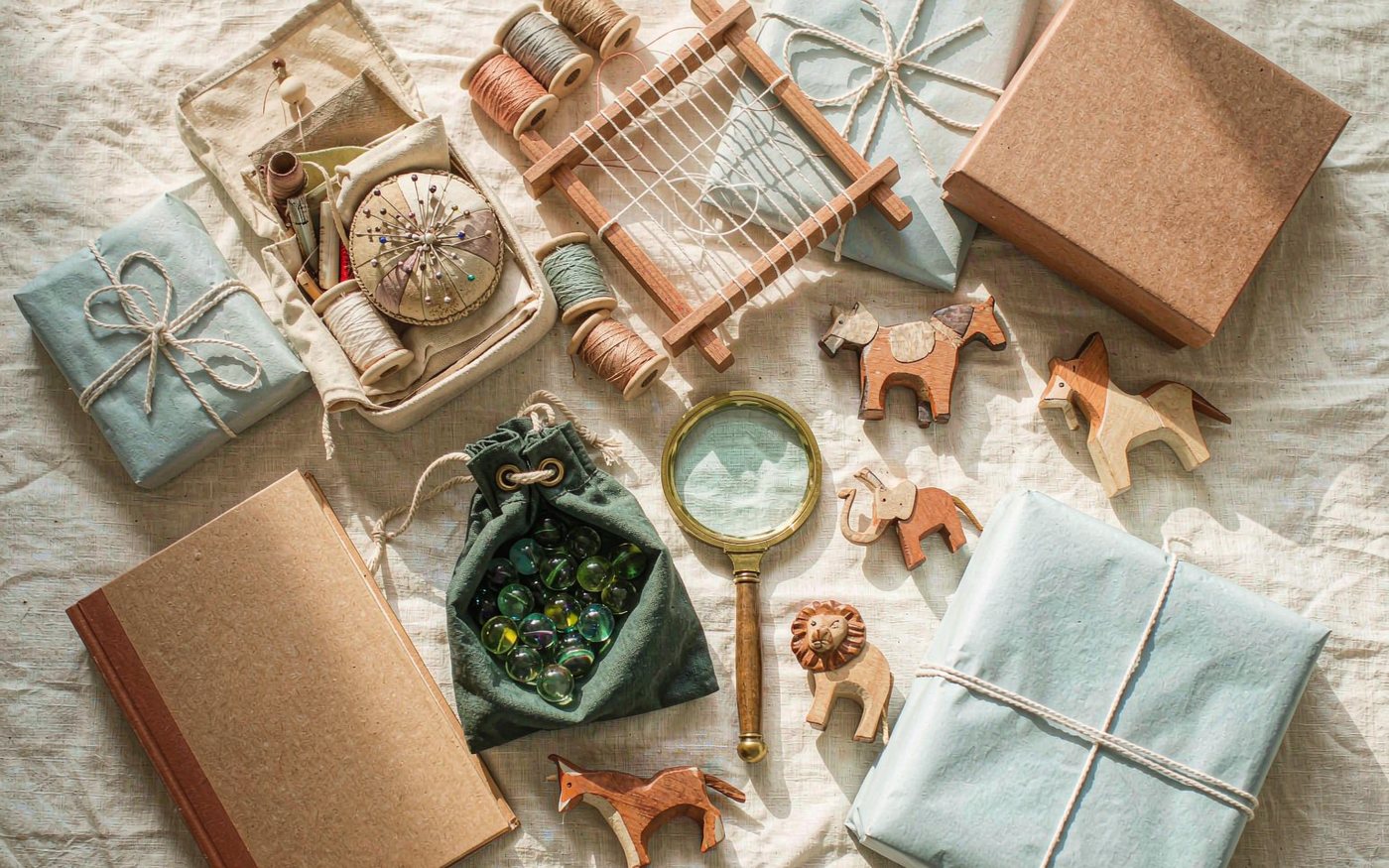
A sewing kit with real fabric. Not felt shapes to glue. Real cotton, a proper needle, and a project book — a first tote bag or a simple skirt is achievable at eight and the pride is disproportionate.
A knitting loom or French knitter. Faster than needles, forgiving of mistakes, and it produces a continuous object, which is exactly the feedback loop an eight-year-old needs.
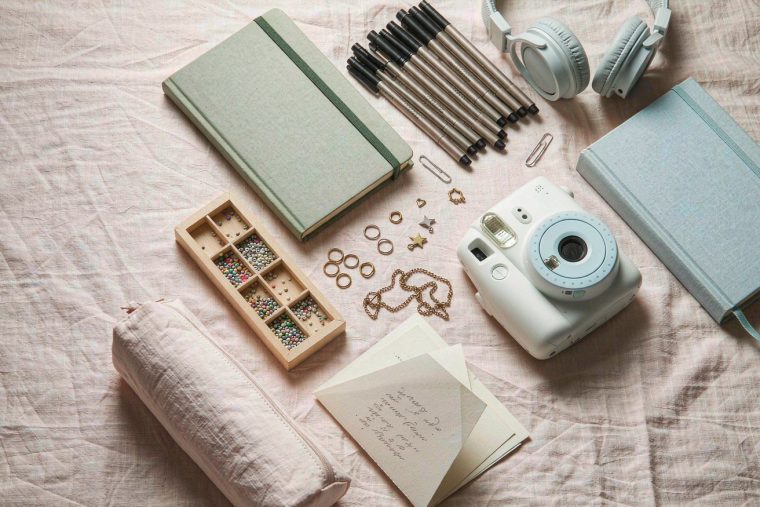
Bead looming and simple jewellery making. Real findings rather than plastic beads; the difference between something she wears and something that goes in a drawer.
A decent set of drawing pens and a hardback sketchbook. This is the age where drawing becomes deliberate rather than exploratory, and cheap materials start to feel like a limit.
Clay with proper tools. Air-dry, so no kiln and no adult supervision. Add a set of sculpting tools rather than relying on fingers.
Print-making or stamp carving. A surprisingly good fit at eight: the tools are sharp enough to feel real, the results are immediate, and it repeats.
What to avoid in this group: anything with a photographed finished product that only an adult could make, and resin kits — the two-part resins are sensitisers and the curing is not a child’s job.
Books and the reading ladder
The most reliable gift at this age and the easiest to get wrong, in a specific direction: books bought too hard are worse than books bought too easy. A child who is handed something above her level learns that reading is a chore. A child who finishes three books in a fortnight learns that reading is something she does.
Series, above all. The value of a series is that the next book is a known quantity — same characters, same length, no decision to make. Ask a parent what she is reading; this is the single highest-return question in this entire article.
Graphic novels. Frequently dismissed by adults and consistently the thing that gets read most. The pictures are doing work the text is not, and volume is what builds fluency.
Illustrated chapter books for the child who is between stages — plenty of pictures, real chapters, no shame in the format.
Browse books. Records, animals, space, “why” books, atlases. Not read start to finish; opened at random for four minutes at a time, dozens of times. Ideal for a child who says she does not like reading.
Joke and fact books. The most-used book you will ever buy, and the one you will regret by 8 a.m.
Building and engineering
Eight is close to peak ability for following instructions — she can hold a sequence in her head, find the right piece, and correct a mistake without starting over. This is the year engineering sets stop being frustrating and start being satisfying.
Standard brick sets in the 300–700 piece range. Big enough to be a project, small enough to finish in two sittings. The number to check is pieces-per-sitting, not the age on the box.
Magnetic tiles. If she already has a set, more pieces is a better gift than a different system, because it upgrades everything she owns.
Marble runs and track systems. The appeal is the engineering loop: build, test, fix. Cheap versions fall apart and teach the wrong lesson, so this is a category where the mid-price option is the right one.
Snap-together circuits. Lights, buzzers, switches, no soldering. The best of these are effectively a physics lesson disguised as a toy, and they work unsupervised from about seven.
On the girls’ version question: a construction set marketed to girls is often the same brand’s set with fewer pieces and a simpler mechanism for the same money. Compare piece count before you compare colour. There is nothing inherently masculine about a gear train, and the deeper version of this argument is in our guide to building toys that hold up like LEGO.
Science and the observable world
Works for the child who asks why, and fails for the child who does not. The test is not whether she likes “science” but whether she has ever brought you something from the garden to identify.
A real microscope with prepared slides, a rock tumbler (if there is somewhere noisy to run it), crystal-growing kits, binoculars, a bug viewer with a grid, a pond-dipping net, a weather station, a magnet set with actual labelled poles. Most of these are cheap, and the ones that work are the ones that turn something ordinary into data.
What to avoid: kits where the “experiment” is a demonstration the adult performs while the child watches. The test is whether she can run it again tomorrow on her own.
Games, including the ones where she loses
Eight is the age where losing becomes survivable, which makes it the age when real games open up. Games are also the highest-value gift for a family with more than one child, because they are used by everyone.
Co-operative games first — the ones where the players beat the board rather than each other. They teach the rules without the sting, and they work with a younger sibling in the room.
Family games for four or more players that take under forty minutes. Anything longer does not get played on a school night, and anything shorter than fifteen minutes gets played forty times.
Card games in small boxes. The best value per dollar in this entire article. A good two-player deck game costs very little and gets played for years.
Puzzles in the 300–500 piece range. At eight the piece count that used to be impossible becomes a two-evening project, and a puzzle is the only gift on this page that reliably produces a quiet hour.
Moving
The only category that competes with a screen on its own terms. Two rules matter more than the product.
Buy the right size, not the size up. Kids’ bikes are sized by wheel and standover height, not by age; skates are sized by the actual boot; a scooter that is too tall is unusable and a bike that is too big is dangerous. Gear she cannot use this year does not get used next year either, because by then it is the wrong thing.
Buy the safety kit at the same time. A helmet that fits, and pads. This is not optional at the age where risk appetite rises faster than coordination.
What works: a scooter upgrade, roller skates or ice skates, a bike in the correct frame size, a skipping rope that is not a toy, a basketball or netball, swimming gear, a gymnastics or dance class as a term. A trampoline is the best cost-per-hour purchase in this article if it is used and the worst if it is not.
Technology that does one thing
At eight, the tech gifts that work are the ones that extend something she already does rather than the ones that open a new front. A camera for a child who photographs everything; headphones for the car; a tablet if the family has decided on one.
Our guides to kids’ cameras, kids’ headphones, and kids’ tablets cover the checks that matter. The one rule that applies to all of them: before buying anything with an app, confirm the company is still trading and the app was updated this year. A connected toy whose servers are switched off becomes a plastic brick with a speaker in it — that is what happened to Moxie, and it is why this site checks the service before the specification.
One thing not to buy at eight: a phone. If the family is going to do that, it is a family decision, and it belongs to a different conversation than a gift list.
Collections, money, and the small economy
Overlooked by adults and genuinely exciting at eight. The pleasure is not in the objects; it is in the system — sorting, completing, trading, deciding what a thing is worth.
A purse with a zip, a small lockable box, a display shelf or a binder with pockets for whatever she collects, a coin counting jar, a wallet. Then add to the collection itself: stickers, crystals, pins, small figures, cards she is already gathering.
One caution that belongs here rather than in the safety section: blind boxes and randomised packs. These work on the same mechanism as gambling — variable reward, near-miss design, and a set that can never quite be completed — and regulators in several countries have spent the last decade pushing back on the digital version of exactly this. A physical blind bag is not illegal and not catastrophic, but a child who is given five of them learns to want the sixth. If she likes the collection, buy the specific item she is missing rather than the gamble.
Her room, her taste
The cheapest category per unit of delight, and the only one where she is in charge. At eight the desire for a space that is hers becomes explicit.
A desk or a small table at her height, a lamp, a pinboard with real pins, a shelf she can reach, a mirror, bedding in a pattern she picked, a set of boxes for the collection. Give her a budget and let her choose rather than choosing for her — a thing she picked is worth three things she was given.
Birthday-party gifts, which is where most of this money actually goes
At eight, a child attends somewhere between eight and fifteen birthday parties a year, and the person searching for a gift is frequently a parent buying for someone else’s child with a $15–25 budget and no idea what the child owns. This is a different problem from buying for your own, and it deserves its own answer.
The reliable trio: a book in a popular series, a craft kit with a contained outcome, and a small consumable set (good pens, decent stickers, a sketchbook). Any two of those, wrapped, is a gift nobody is disappointed by.
Better if you know the child: add to something they collect, or buy the specific item they are missing rather than a random pack.
What not to buy for someone else’s child: anything loud, anything that needs batteries, anything with a hundred small pieces, anything requiring an adult to supervise, and slime. All five are gifts for the parent’s patience rather than the child’s delight, and the parent will remember which one you were.
Include a gift receipt where you can. It converts a guess into a choice and costs nothing.
What to skip
Skincare and cosmetics with active ingredients. The same problem as at ten, arriving earlier every year. Children’s skin does not need exfoliating acids or retinoids, and a “routine” is marketing. A lip balm and a mild cleanser are sufficient.
The pink downgrade. Same concept, fewer parts, higher price. Compare piece counts.
Blind boxes in multiples. Covered above. The mechanism is the product.
Books above her reading level. Bought with love, and the most common cause of a child deciding she does not like reading.
Anything with a button battery in a compartment she can open, and small high-powered magnets. A swallowed coin cell can burn tissue within a couple of hours; two magnets that meet across a loop of intestine cause damage that does not show for days. Both should not be in the house with young children, let alone in a gift bag.
Unlabelled slime, putty, and mystery compounds. No ingredient list and no manufacturer address means nothing to check and nobody to ask.
Giant plush. Delightful for one afternoon, and then it lives on the floor of a room that has no floor space. If she wants a soft thing, buy a small one she will actually carry.
The budget ladder
Under $25. The strongest band at this age. A book in a series, a good sketchbook with pens, a card game, a small craft kit, an addition to her collection.
$25–$60. The sweet spot. A mid-size building set, a sewing or jewellery kit with real materials, a decent pair of headphones, a scooter upgrade, a proper board game.
$60–$150. One substantial thing: a bike in the right size, a microscope, a dollhouse or small-world set, a tablet if the family is buying one, a term of a class.
Above $150. At this level the question is whether it is a shared family asset. The two failures are buying a subscription-dependent product at the top of the market and buying the version the adult finds impressive.
A structure that works at every level: one thing she can get good at, one thing she can do with a friend, one thing that gets used up. That combination beats a bigger pile at the same total.
If you do not know her
A book in a series, a craft kit with a contained outcome, and something for her room with the receipt. If you want one answer: a good hardback and a set of decent pens, wrapped properly. It is never wrong, it is never duplicated, and it is never outgrown in a month.
Money is also welcome at eight in a way it was not at five — she now has plans for it. Pair it with a small object so there is something to unwrap.
FAQ
What is a good gift for an 8 year old girl who has everything?
Additions rather than replacements: more pieces for a set she already has, the next book in a series, the specific item missing from her collection, or a better version of something she uses daily. The category that almost always works is “more of the thing she is already into.”
Is 8 too old for dolls?
No, and the elaborate pretend play of this age is a sign of healthy development rather than a delay. The distinction that matters is scale and detail: a well-made doll with real clothes is a different object from a toddler toy, and eight-year-olds are specific about which one they want.
How much should a birthday party gift cost for an 8 year old?
In most US communities the customary band is $15–25, and going far outside it creates awkwardness for the other parents. A book and a small craft kit at the lower end of that band is a better gift than a $40 object nobody knows what to do with.
What should you buy an 8 year old girl who only likes screens?
Buy into the interest rather than against it. A camera, headphones, a game that requires a second player in the same room, or a book about how games are made will all get used. What will not get used is a toy chosen specifically to lure her away from the screen, because she can tell what it is for.
Are blind boxes and surprise toys OK?
One is a treat; a habit is a different thing. The mechanism — variable reward, near-complete sets, near-miss design — is the same one regulators have spent a decade pushing back on in digital games. If she collects a set, buy the specific piece she is missing instead.
What are good gifts for an 8 year old girl who does not like crafts?
Physical things she can get better at, games that need other people, books, and anything that extends a collection. The craft cluster is the easiest to buy for, not the only one that works.
When should you buy for the holiday season?
Late October to mid-November, while stock is complete. By the second week of December the popular items in the $25–$60 band are gone, and after about 18 December you are choosing from what is physically in a shop near you.
How we put this together
This is a category guide built from research and published standards rather than a set of hands-on product tests, and it should be read that way. Where a claim rests on a regulation, a study, or a documented failure pattern — the small-parts rule, magnet and button-battery injuries, dermatological guidance on children’s skincare, the design of randomised reward mechanics — the source is named rather than dressed up as experience we do not have. Where we describe how a category behaves over months, that reflects use in our own households and in conversations with families.
We do not publish star ratings, because a number implies a measurement we did not take. Our standard and the four verdict labels are on the how we test page, and corrections are dated rather than quietly edited.
The other guides in this series: the ten-year-old girls guide for the next stage up, the twelve-year-old girls guide for the year the toy aisle stops working, the ten-year-old boys guide, the Christmas gifts for kids hub covering every age band from one to twelve, and the stocking stuffers guide for the small things. Everything else for the season is in Gift Guides.