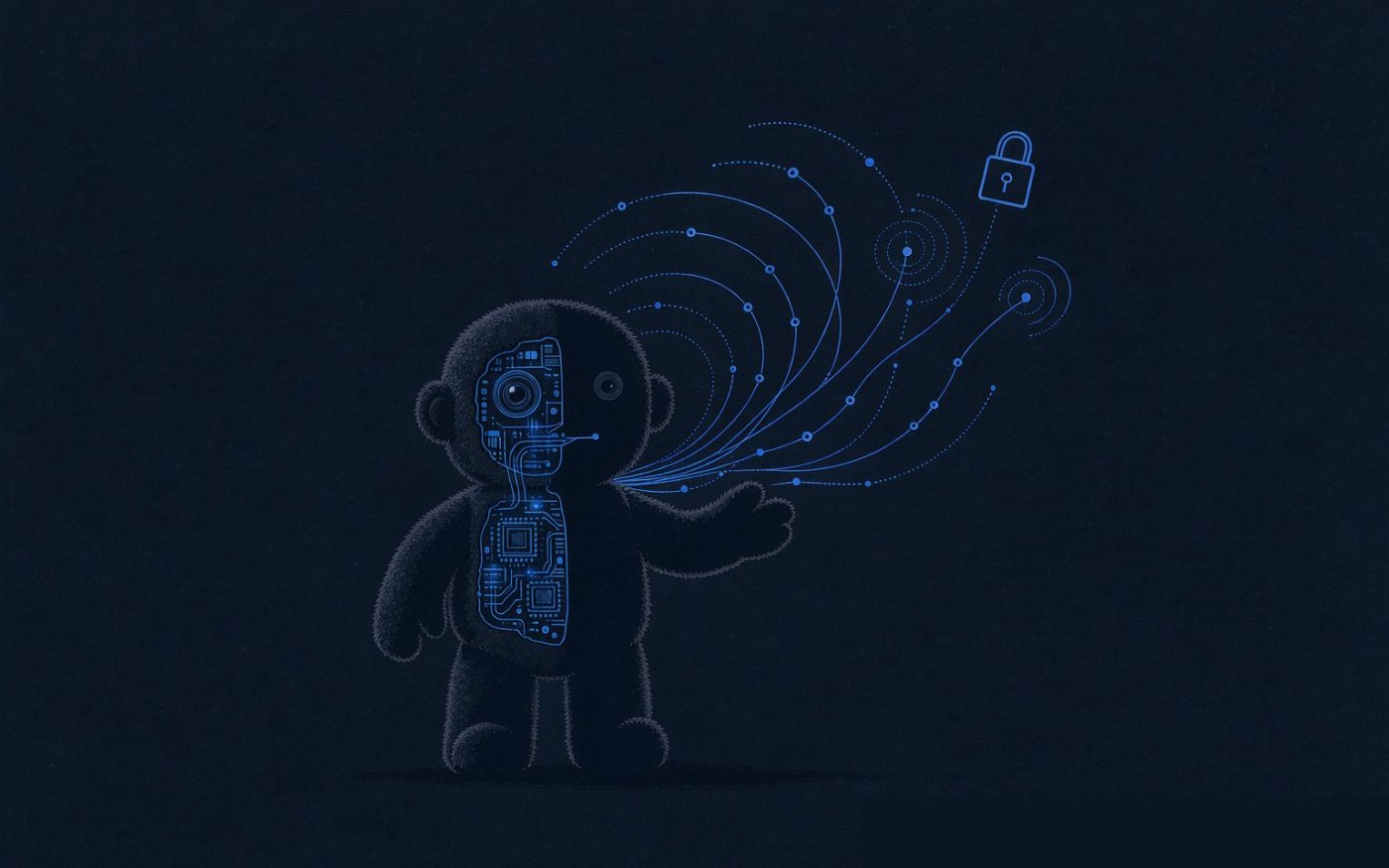
Short answer: a smart toy is as physically safe as a conventional toy with the same label on the box. What the label does not cover is the part that makes it smart — the microphone, the camera, the account, and the server the data ends up on. That is the gap this article is about.
Parents ask us one version of this question more than any other: is this thing safe for my kid? It sounds like a single question. It is actually three, and they have different answers, different regulators, and different failure modes.
Three kinds of safety, three different rulebooks
Physical safety covers sharp edges, small parts, choke hazards, flammability, and the presence of heavy metals in paint. This is the oldest and best-tested layer. In the United States it is governed by ASTM F963 — the current edition is F963-23 — and enforced through the Consumer Product Safety Commission; in Europe the equivalent is the EN 71 series under the Toy Safety Directive. A toy sold in either market with the right mark has been tested for these hazards.
Electrical and battery safety covers charging circuits, heat, and — the one that actually causes injuries — button cells. A lithium cell small enough to swallow is a medical emergency, and coin cells are still found in toys that a two-year-old can open. This layer is regulated too, but enforcement depends on the importer, and the inexpensive end of the market is where it slips. In the United States, the Reese’s Law rules that took effect in 2023 now require a tool — usually a screwdriver — to open a compartment holding a coin cell, plus child-resistant packaging on the cells themselves. If a toy you are looking at has a battery door a fingernail can flip, that is a design decision someone made after the law was written.
Data safety covers the microphone, the camera, the Wi-Fi radio, the companion app, and the account you have to create. This is the layer with the weakest guarantees. There is no equivalent of ASTM F963 for “what happens to the recording of your child’s voice.”
What the marks actually certify
This is where most buying advice goes wrong, so it is worth being precise. A CE mark, a UKCA mark, or an ASTM F963 conformance statement tells you the manufacturer has addressed physical and electrical hazards. None of them tell you anything about the software, the account system, or the retention policy.
For the data layer the rules are separate and much newer. In the United States, COPPA constrains what a service directed at children under 13 may collect and requires verifiable parental consent. In Europe, the GDPR treats a child’s voice recording as personal data, and the UK’s Age Appropriate Design Code sets fifteen specific standards for services likely to be accessed by children. These are real obligations — but they bind the manufacturer, and you have no way to audit compliance from the outside.
There is no consumer-facing label that tells you whether a toy’s microphone streams to a server, whether it stores audio locally, or whether anyone has looked at the firmware.
One consequence worth internalising: a toy can hold every mark in this article and still be a bad purchase, because the marks are silent on the only layer that changed when the toy got a chip in it.
Where connected toys have actually failed
The failure record is short but consistent, and it is almost never a hardware failure. It is a database failure.
In 2015, VTech disclosed a breach affecting millions of parent and child accounts, including photographs and chat logs. In 2017, CloudPets left a database of voice recordings and account credentials publicly exposed. Neither incident required anyone to break into a toy. In both cases the data existed at all because the product design collected it, and it was reachable because the storage was misconfigured.
The same year produced a different kind of failure. Germany’s Federal Network Agency ordered retailers to stop selling the My Friend Cayla doll and told parents to destroy the one they owned, on the grounds that its unsecured Bluetooth module made it a concealed transmitting device — anyone within range could connect to it and listen. Nothing about that doll was defective. It was compliant as a toy and unsafe as a connected device, and those two statements did not contradict each other.
The lesson is not that connected toys are dangerous. It is that the risk is concentrated in the part of the product you cannot see, made by the part of the company you cannot talk to, and disclosed — if at all — in a privacy policy written for a lawyer.
Which toys carry the most risk
Risk is not evenly distributed across the category. It follows one variable: how much of the toy lives on a server you do not control.
Talking companions and voice assistants
These are the highest-exposure products in the category, because the input is a child’s voice in a room, and the business model usually requires that voice to be processed somewhere. Ask three things: whether audio is processed on the device or uploaded, whether the toy records continuously or only after a wake word, and whether the parent can see what has been recorded. If the answer to the third is no, nobody — including the manufacturer’s support team — can tell you what is sitting in that account.
Cameras and baby monitors
Cameras fail differently: not through a data breach you read about later, but through a live stream someone else is watching. The recurring cause is a default or trivially guessable password with the device exposed to the open internet, and the fix is unglamorous — a unique password, two-factor on the account, and firmware that updates. A camera that has not received a firmware update in two years is not a camera with a good safety record; it is a camera nobody is watching.
Bluetooth locators and trackers
Short-range wireless is often treated as inherently safer because it does not touch the internet. The Cayla case is the counter-example: a Bluetooth device with no pairing authentication is open to anyone in the same room. The question to ask is not “does it use Wi-Fi” but “does it require authentication before another device can talk to it.”
Learning tablets and app-connected kits
Tablets and coding kits shift the risk from the toy to the account and the store attached to it. Setup usually requires a parent email, sometimes a birth date, and often a payment method before the free content runs out. The permissions requested at first launch are the honest description of what the product intends to do. If a drawing app asks for contacts and location, that is not a safety feature.
Age changes the answer
The same toy can be a reasonable purchase at six and a poor one at three, and the difference is not the age printed on the box. It is which failure mode the child is exposed to.
Under three
Physical risk dominates so completely that the data layer is almost irrelevant — almost, because a device left running in a cot is still a device with a microphone. The real checks are the battery compartment, small detachable parts, and whether the thing survives being dropped on a hard floor. Any toy in this band that requires an account to function is a toy designed for someone other than the child using it.
Three to five
This is where voice toys enter, and where children start talking to a device without understanding that a recording persists. The account is created and controlled by the parent, which is good, and also means the parent is the only one who can delete anything. Check whether the toy still does something interesting with the network switched off. If it does not, the network is the product.
Six to eight
The highest-risk band for permissions, because this is when a child starts operating the app alone: searching, tapping through menus, and occasionally buying. Parental controls that live inside the same app the child is using are weaker than controls enforced at the account level. Look for a PIN on purchases, not a checkbox in settings.
Nine and up
The risk shifts to social features — chat, photo upload, sharing — and to data retention over years rather than months. A toy that stores a child’s voice from age nine to age fourteen has accumulated a record of a person who never consented to it. Ask what happens to the account when the child outgrows the toy, and whether deletion is possible without closing the whole thing.
Five questions to ask before you buy
You will not get clean answers to all five. The point is to find out which ones the manufacturer has thought about.
- Does it work without the app? If the toy is a brick until you create an account, the account is part of the product, and so is everything it collects.
- Where does the audio or image go? Local storage on the device is a very different proposition from a cloud account. Look for the word “processed on-device” — and treat “we take privacy seriously” as a non-answer.
- Can you delete the data? Not “request deletion by email.” An actual control in the app or the account page.
- Is there a parent-side off switch for the microphone and camera? A hardware switch is better than a software toggle, because a software toggle can be changed by an update.
- When was the firmware last updated? A connected toy without a visible update history is a connected toy that will be abandoned. The app store listing usually tells you.
The answers are also a signal about the company. A manufacturer that publishes a plain-language privacy page and a firmware changelog has usually thought about the sixth question you have not asked yet. A manufacturer whose only data document is a PDF written in legal register has not.
What happens when the company disappears
This is the failure mode parents underestimate most, because it has nothing to do with safety and everything to do with whether the toy still works in two years.
A connected toy is a client. The server it talks to is the product. When the company running that server stops, the toy does not degrade politely — it stops answering. We covered this in detail when Embodied shut down Moxie: a robot that had been on sale for years became a plastic object with a speaker in it, and the customers found out from a support page rather than a plan.
Two practical consequences. First, before buying anything with a subscription or a mandatory account, check whether the company is still trading and when the app was last updated — an app store listing with no update in eighteen months is a warning, not a detail. Second, understand that when the service ends, the data usually ends with it, and not in a way you chose. Export anything you care about while the export button still exists.
Buying secondhand
Secondhand smart toys are cheap for a reason that is rarely explained at the point of sale: the previous owner’s account may still be attached to the device, and their data may still be on it.
Before paying, do a factory reset with the seller watching, and confirm the device is removed from their account — not just wiped. On toys with an app, ask the seller to unbind the serial number in the app first, because a device that is still registered to someone else will refuse to pair with you. On anything with storage, assume a reset clears the settings and not necessarily the media. And check the firmware version against the manufacturer’s current one; a secondhand toy two years behind on updates is the least likely device in your house to get the next one.
None of this is a reason to avoid secondhand. It is a reason to spend five minutes at the handover instead of twenty minutes on support afterwards.
A checklist you can screenshot
Six checks, in the order that matters. If a product fails the first column, the rest is irrelevant.
| Check | Passes | Fails |
|---|---|---|
| Market mark | ASTM F963 statement (US) or CE/UKCA with EN 71 (EU/UK) | No mark, or a mark with no test report on request |
| Battery compartment | Requires a screwdriver or a tool to open | Fingernail latch over a coin cell |
| Works offline | Core play continues with Wi-Fi off | Brick without an account and a connection |
| Data location | “Processed on-device” stated plainly | No page, no answer, or “we value privacy” |
| Deletion | A delete button in the app or account | “Email us to request deletion” |
| Company status | App updated within the last year, company trading | Last update 18+ months ago, no changelog |
What we check before recommending one
We are a research desk, not a test lab, and we do not claim to have played with everything we write about. What we can do is check the things that are checkable from the outside — which is more than most buying guides do.
For a connected toy, the data layer is treated as one of our six standing checks rather than a footnote: what the app asks for at setup, whether those permissions are proportionate to what the toy does, whether it still functions offline, and whether there is a real way to delete what has been collected. The six checks are listed here, along with the four labels we use and the claims we refuse to make.
The second thing we do is check the age claim against what parents report, rather than against the box. A toy rated for three and up is routinely being bought for a two-year-old sibling, and reviews written by parents of younger children are the only place that gap shows up. When the two numbers disagree by two years, we say so in the article.
Where to report a problem
If a toy injures a child, or you find a hazard the label did not warn about, reporting it is more useful than returning it. In the United States, SaferProducts.gov takes reports directly and they feed the CPSC recall system. In the EU and UK, the equivalent route is your national market surveillance authority; the EU’s Safety Gate publishes alerts on products already flagged. Both are public, which is why the failure record in this article exists at all.
For a data problem — an app that will not delete an account, a toy that keeps recording after being switched off, a camera reachable from outside the home — the manufacturer’s support channel is the first stop, and a written record of the response is worth keeping. Regulators take pattern evidence far more seriously than single complaints, and in the United States the body that enforces COPPA is the Federal Trade Commission, which publishes both the rule and the route for a complaint.
The practical version
If you take one thing from this: buy the physical safety from the label, and buy the data safety from the manufacturer’s behaviour. The label is a floor, not a guarantee. Check that the toy has the mark for your market, check that the battery compartment needs a screwdriver, then spend five minutes on whether the app needs an account and what it wants access to.
If a manufacturer cannot answer question two in plain language, that is your answer.